
Why Mortgage Rates Are Still Around 6.7% and What It Means for Bemidji Home Buyers
If you have been thinking about buying a home in Bemidji but are waiting for mortgage rates to drop significantly first, it is worth understanding what is actually keeping rates where they are.
There is a common assumption that the Federal Reserve directly controls mortgage rates. It does not.
While Fed policy can certainly influence the overall interest-rate environment, 30-year mortgage rates tend to move much more closely with longer-term bond yields, especially the 10-year U.S. Treasury.
And right now, one particular piece of that relationship helps explain both why mortgage rates are still elevated and why they are not even higher.
Mortgage Rates and the 10-Year Treasury
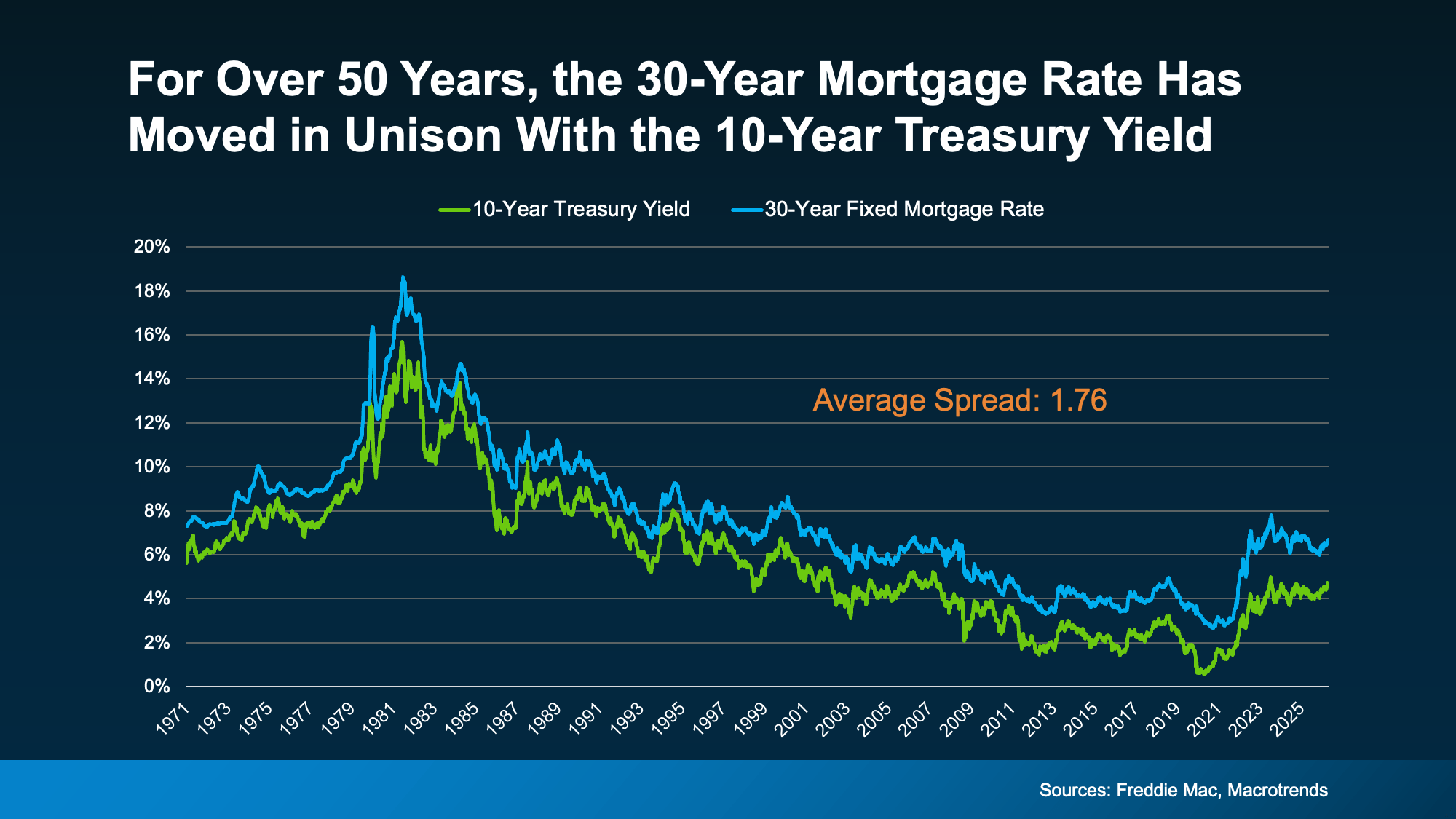
The 30-year fixed mortgage rate and the 10-year Treasury yield have historically moved in the same general direction.
They are not identical, and mortgage rates are influenced by additional factors such as mortgage-backed securities, lender costs, market volatility, prepayment risk, and investor demand. But the 10-year Treasury is still a useful benchmark for understanding where mortgage rates are headed.
The difference between the mortgage rate and the 10-year Treasury yield is commonly called the mortgage spread.
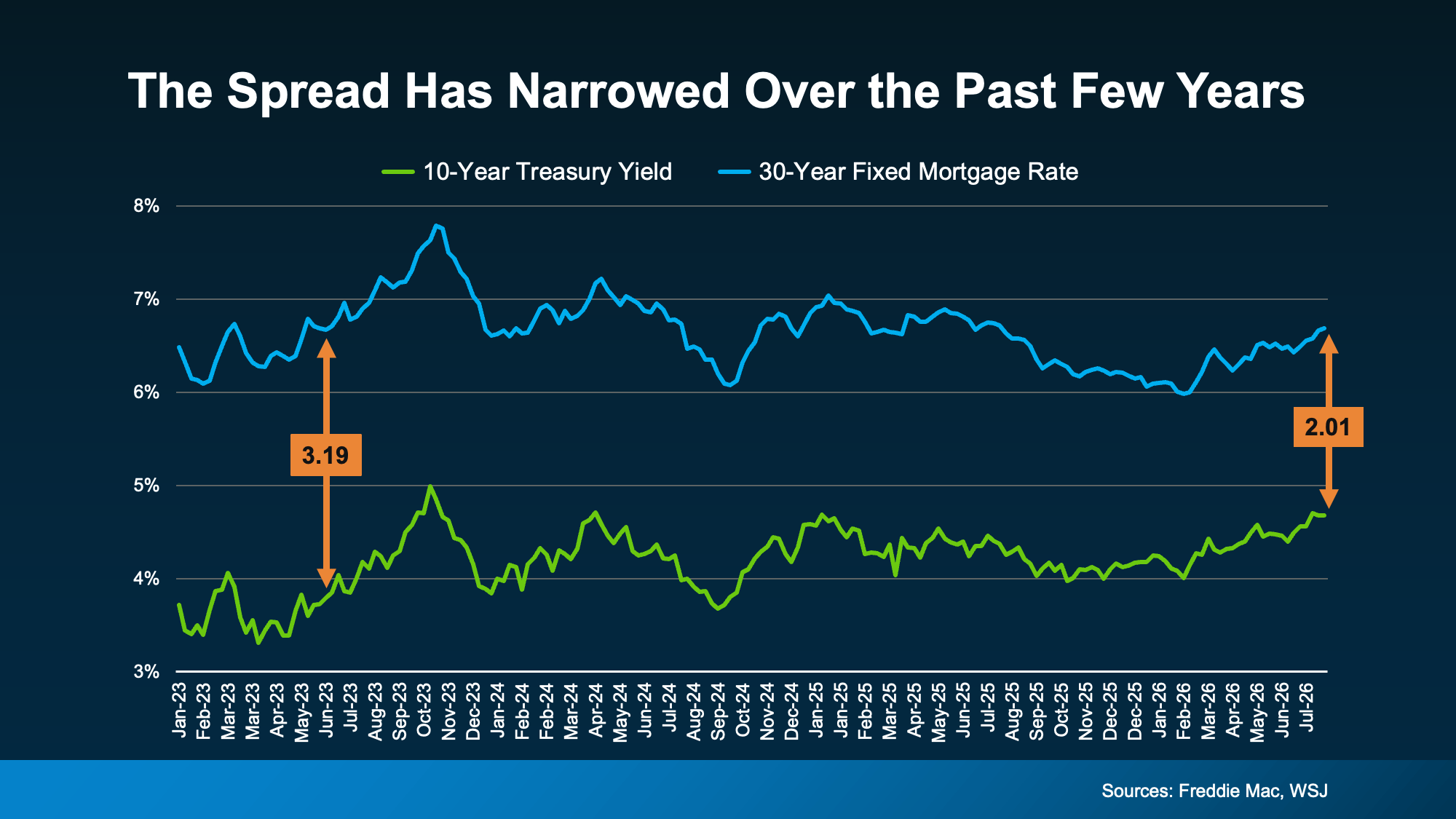
For example, as of August 18, 2026, Mortgage News Daily's national 30-year fixed-rate index was approximately 6.75%. The 10-year Treasury yield was 4.72% on August 17. That leaves a gap of roughly 2 percentage points.
Keeping Current Matters puts the historical average spread at roughly 1.76 percentage points.
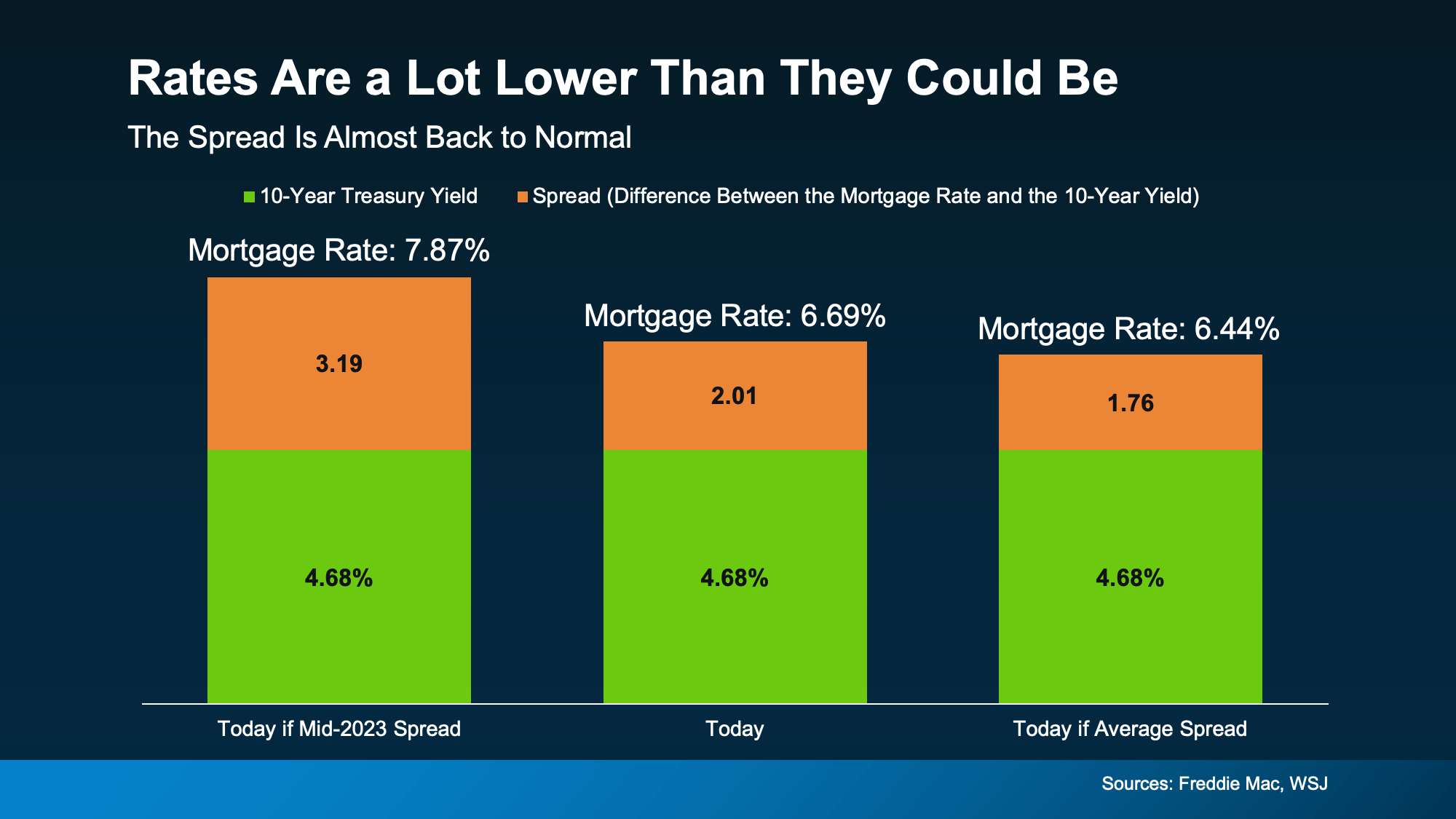
So today's spread is still somewhat elevated, but it is much closer to normal than it was a few years ago.
Why That's Actually Good News
Back in 2023, the spread between mortgage rates and the 10-year Treasury became unusually wide, reaching more than 3 percentage points.
If we still had a spread like that today with a 10-year Treasury yield in the upper 4% range, mortgage rates could be much closer to 8%.
Instead, the spread has narrowed considerably. That narrowing has helped keep current mortgage rates in the upper 6% range rather than allowing them to climb substantially higher.
So while a 6.5% to 7% mortgage rate may not feel particularly exciting, there is another way to look at it:
Rates are already benefiting from a mortgage spread that has moved much closer to its historical norm.
Why That May Limit How Far Rates Fall
This is also where things get interesting for buyers who are waiting for a major decline in rates.
When the mortgage spread was extremely wide, there was a lot of room for mortgage rates to improve simply by that spread returning to normal.
Much of that normalization has now happened.
That means getting from roughly 6.7% to something like 6.5% is one thing. Getting all the way down into the low 5% range would likely require a meaningful decline in longer-term Treasury yields as well.
There is no way to know exactly where rates will go next. Economic growth, inflation, employment, government borrowing, geopolitical events, Federal Reserve policy, and investor expectations can all move the bond market.
But I would be hesitant to make a home-buying decision based entirely on the assumption that dramatically lower mortgage rates are just around the corner.
What Does This Mean for a Bemidji Home Buyer?
This becomes easier to understand when you put actual numbers behind it.
Let's use a $250,000 Bemidji home with 10% down as a simple example. That would leave a mortgage of approximately $225,000.
On a 30-year fixed mortgage, principal and interest would be approximately:
Interest RateApprox. Monthly Principal & Interest6.75%$1,4596.50%$1,4226.00%$1,349
These numbers do not include property taxes, homeowners insurance, mortgage insurance, HOA fees, or other costs.
What I find interesting is the difference between 6.75% and 6.50%.
It is about $37 per month on this example.
A three-quarter-point drop from 6.75% to 6.00% makes a bigger difference at roughly $110 per month, but that still has to be weighed against what happens to home prices, inventory, and competition while you wait.
Bemidji Home Prices Haven't Simply Fallen Because Rates Are High
One argument I hear sometimes is that buyers should simply wait because higher mortgage rates will eventually force home prices much lower.
So far, that has not really been the story in Bemidji.
According to Zillow, the typical Bemidji home value was $223,567 as of July 31, 2026, which was 4.4% higher than one year earlier. Zillow also reported a median list price of about $258,000 in July.
Another dataset from Redfin shows a median Bemidji sale price of about $228,600 over the three months ending in June, up 1.4% from the same period a year earlier.
Different housing datasets measure the market in different ways, so I would not get hung up on the exact percentage.
The bigger takeaway is that home values around Bemidji have remained fairly resilient even with mortgage rates staying elevated.
Higher rates have absolutely affected affordability and buyer behavior. But they have not automatically translated into dramatically lower home prices.
So, Should You Wait for Lower Mortgage Rates?
It depends.
If today's payment simply does not work for your budget, there is nothing wrong with waiting. Buying a home should make financial sense for you.
But if you are financially ready to buy, you find the right home, and you are comfortable with the payment, I would not necessarily pass on the property solely because you are hoping rates will be significantly lower six months or a year from now.
Nobody knows where rates will be then.
You could get a lower rate.
You could also see similar rates, higher home prices, fewer homes that fit what you want, or more competition from other buyers if rates do eventually fall.
The important part is looking at the entire picture rather than trying to perfectly time one number.
What About Sellers in Bemidji?
Mortgage rates matter for sellers too.
Buyers today tend to be much more payment-conscious than they were when mortgage rates were 3%.
That makes things like pricing, condition, presentation, and marketing even more important.
A buyer may love a home, but if the price pushes their monthly payment beyond what they are comfortable spending, they may move on to the next property.
That does not mean sellers need to give their homes away. It means understanding the current market and positioning the property correctly matters.
Bottom Line
Mortgage rates are still elevated, but one of the most unusual factors that pushed them higher a few years ago has already improved considerably.
The spread between mortgage rates and the 10-year Treasury is now much closer to its historical average. That is part of the reason mortgage rates are not closer to 8% today.
It is also one reason buyers should be careful about assuming a dramatic drop in rates is inevitable in the near future.
If you're thinking about buying a home in Bemidji, the lakes area, or elsewhere in Northern Minnesota, I would focus less on trying to perfectly time mortgage rates and more on whether you can find the right property at a monthly payment that works for you.
If you want to talk through what is currently available in your price range, feel free to reach out.
Tyler Montgomery
REALTOR® | Team Montgomery at 218 Real Estate
218-308-1230
tylermontgomery.com
Mortgage rates and payment examples are provided for general educational purposes. Actual rates and payments vary based on borrower qualifications, loan program, down payment, lender, taxes, insurance, and other factors.